The President of the Government calls for regulation against "tech oligarchies" at the Kennedy Forum at Harvard University, defending the Spanish model with over €40 billion invested in AI and quantum computing.
The President of the Government, Pedro Sánchez, spoke this Thursday at the John F. Kennedy Jr. Forum of the Kennedy School's Institute of Politics at Harvard University in Boston (United States), where he called for regulation of big tech companies in light of the risks they pose to democracies. The information, released by the official site of La Moncloa, notes that the president focused his speech on the need to control the "new technological oligarchies."
Sánchez began his speech by quoting the jurist Louis Brandeis, who was educated at Harvard and is considered one of the architects of the American rule of law, to draw a parallel between the fight against monopolies in the late 19th century and the current power of large digital companies. He recalled that Brandeis "believed that prosperity should be shared" and that the only way to guarantee it was "to prevent large concentrations of economic power."
The president warned that many of the algorithms that underpin technologies like artificial intelligence "are not built to serve us; they are built to enslave us." In his view, their purpose is "to weaken our critical thinking, distort public debate, and turn our attention into profit," with the aim of pushing a political agenda that only serves a few.
"Each of these technologies is controlled by a few men who publicly disdain democratic institutions, laws, and the liberal values that have guided our societies since the end of World War II"
Sánchez raised concerns about the lack of control, transparency, and accountability of companies developing increasingly powerful capabilities. In response to those who argue that deregulation will bring more competitiveness, he countered that "speed is useless if we are heading in the wrong direction" and insisted on "finding a way to make these technologies benefit us, the citizens, and not a handful of techno-oligarchs."
The president clarified that his position does not imply rejecting technological advancement. He recalled that over the past eight years, the Government of Spain has invested more than €40 billion in the development and adoption of technologies such as artificial intelligence and quantum computing, and defended their potential to tackle challenges like climate change, demographic decline, or inequality. "I am not suggesting that we get rid of these technologies. I say that we must control and supervise them," he emphasized. "We should also slow down their development until we find a way to make this technology safe and channel its power towards the goals we truly have as a society," he added.
Among the measures adopted by his government, Sánchez listed the criminalization of algorithmic manipulation, the restriction of access to social networks for those under sixteen, the creation of public tools against hate speech, and the legislative proposal to hold platform executives legally accountable. "Those who create the risk and benefit from it must also take responsibility," he stated.
He also highlighted that Spain was the first Western country to approve a Digital Rights Charter and has launched the first Artificial Intelligence Supervision Agency in Europe. On the international front, he advocated for joint action because "the digital space is like the atmosphere: there is only one. If we want to save it, all our countries must act at the same time."
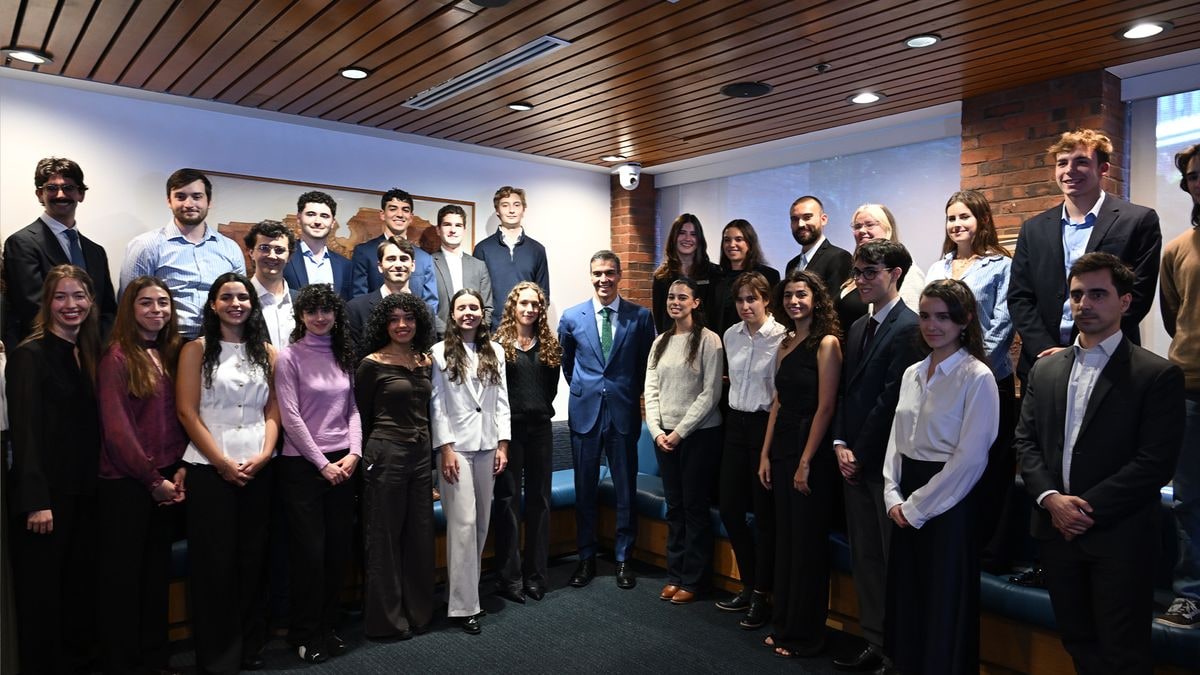
During the day, Sánchez met with the dean of Harvard College, David Deming, and the dean of the Faculty of Arts and Sciences, Hopi Hoekstra, as well as holding a meeting with Spanish students and researchers. He also had a meeting with the governor of Massachusetts, Maura Healey, with whom he discussed the challenges faced by those defending social and democratic rights, gender equality, and the rights of migrants.

You may also like