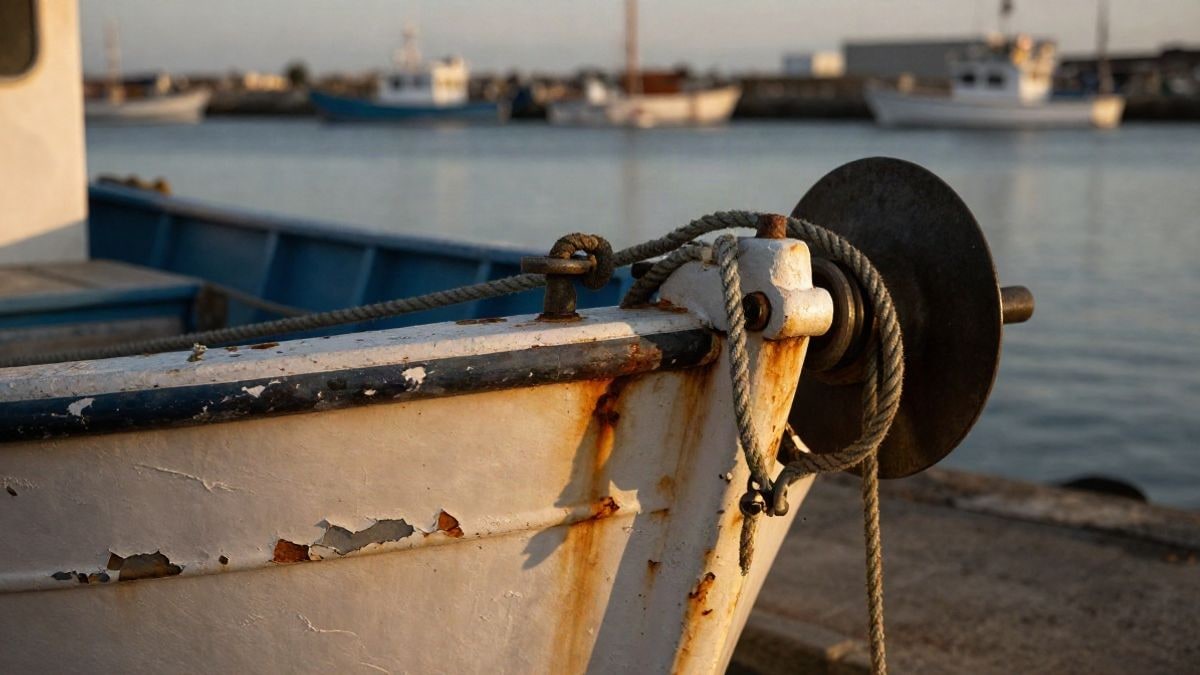
Facope urges the Ministry to update aid that has been frozen for over twenty years. The president of the federation and mayor of Punta Umbría calls for safer, more efficient boats adapted for women.
The fishing fleet of the Gulf of Cádiz needs renewal, and the sector is asking the Ministry of Agriculture, Fisheries and Food to update the support amounts, which, according to the fishing guilds, have remained frozen for over two decades. This demand was conveyed on Tuesday by the president of the Andalusian Federation of Fishermen's Guilds (Facope), Manuel Fernández Belmonte, during a visit to the port of Punta Umbría alongside the local mayor, José Carlos Hernández Cansino, as reported by Huelva Información.
Fernández Belmonte, who is also the mayor of the Santo Cristo del Mar Fishermen's Guild of Punta Umbría, defended the need for a fleet that is "renewed, safer and more efficient". In his view, this is not just an economic issue but also about "the safety and well-being of those who go out to sea every day".
The Government itself acknowledges the problem of the age of the boats. The Minister of Agriculture, Fisheries and Food, Luis Planas, pointed out on 18 June 2025 in Congress that the average age of the Spanish fleet is over 35 years and placed its renewal among the Executive's priorities, aiming to build "safer, more efficient and habitable" vessels, with financing to be considered in the next European financial framework.
"Renewal should not be limited to the efficiency of vessels but should also translate into better working and living conditions on board"
Facope insists that modernisation must include better working and living conditions on board. Fernández Belmonte highlighted the inclusion of women in a traditionally male-dominated activity and deemed it necessary for boats to have appropriate spaces and facilities, such as cabins and toilets, so that men and women can work under suitable conditions. He links this adaptation to generational change and making the profession more attractive.
The Secretary General of Fisheries, Isabel Artime, had already warned of this problem on 12 February 2025 at the VI International Maritime Congress: only 27% of those affiliated with the Special Regime of the Sea are under 40 years old. Artime argued then that securing the future of the activity involves rejuvenating the fleet, modernising the boats, and improving the working conditions of the crews.
Renewal also has an energy aspect. The president of Facope called on Europe to explore alternatives to reduce dependence on traditional fuels and to promote research and development of solutions such as the electrification of vessels.
The request comes a day after the European Commission presented on Monday, 21 September, a proposal to amend the regulation of the European Maritime, Fisheries and Aquaculture Fund (EMFAF). Brussels proposes to relax the rules for engine replacement and modernisation of boats, facilitate projects and investments related to the energy transition, and increase the intensity of aid aimed at young fishermen.
The sector also demands resizing the fleet to adapt it to the fishing of clams, a resource that conditions the activity in the area.

You may also like