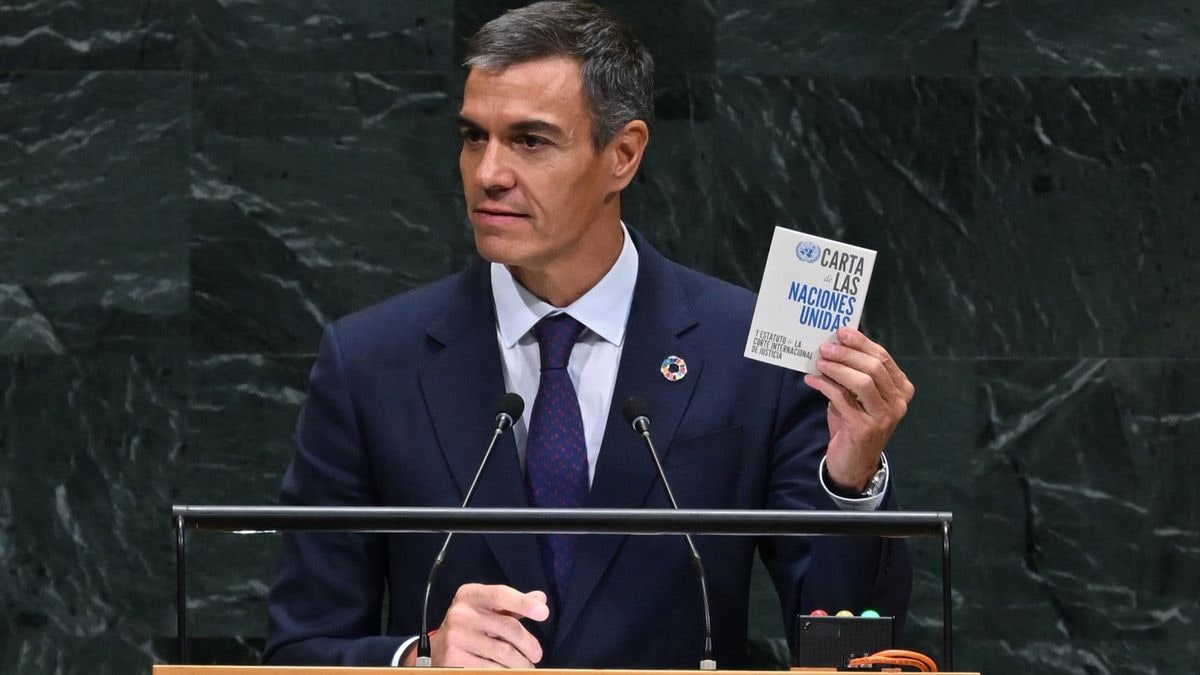
The President of the Government, Pedro Sánchez, has called at the UN General Assembly for reform of the Security Council to eliminate the veto right and achieve fair representation for all regions. He has also requested that a Latin American woman lead the organisation.
The President of the Government, Pedro Sánchez, spoke this Wednesday at the United Nations General Assembly in New York, demanding a reform of the Security Council that ends the veto right of permanent members and guarantees fair representation for all regions of the world, according to La Moncloa.
In his speech, Sánchez argued that no nation should be "judge and party at the same time, no matter how powerful it is," and advocated for strengthening the other main bodies of the UN, reorganising agencies, funds, and programmes with more resources and executive capacity, and rebuilding the architecture of non-proliferation and nuclear disarmament.
"Feminism is one of the main forces of transformation and progress that the world has known, and it is time for it to guide this institution"
The head of the Executive has called for a Latin American woman to assume the next leadership of the United Nations, a historical debt that, in his opinion, must be settled now, when feminism is under attack and thousands of women are victims of machismo, violence, and xenophobia.
Sánchez recalled his first intervention in that Assembly eight years ago, when the 2030 Agenda was approved, and lamented that since then the world has changed, and in some aspects, it has changed for the worse. He pointed out that ideas such as peace, sustainability, and equal opportunities are being attacked by political actors and governments that want to return society to a grey past.
Without naming them, he referred to those who first question the rules only to then break them without accountability, cut their contributions to multilateral bodies, target their leaders and workers, block their capacity for action, and then describe them as useless entities that can be dispensed with.
In the face of these dynamics, he highlighted the work of governments that continue to bet on cooperation, social justice, and environmental sustainability, and stressed that "multilateralism is the best tool humanity has to manage its diversity and interdependence."
Regarding technological regulation, he urged imposing strict regulations on tech oligarchs to control the functioning of social networks and the development of Artificial Intelligence.
On Spain's position, he highlighted the opposition to all wars and the defence of international law, with measures such as sanctions against Russia for the invasion of Ukraine or the arms embargo on Israel for the genocide in Gaza. He also stated that Spain's contribution to the multilateral system has increased by 60% and assured that the country has doubled its investment in cooperation.
Regarding the situation in Ceuta, he defended that Spain and the Ceuta society remain true to their principles and values, without yielding to fear, turning migrants into enemies, or violating legality, and he expressed confidence that they will emerge from this crisis stronger because they choose "the fairest path."
You may also like